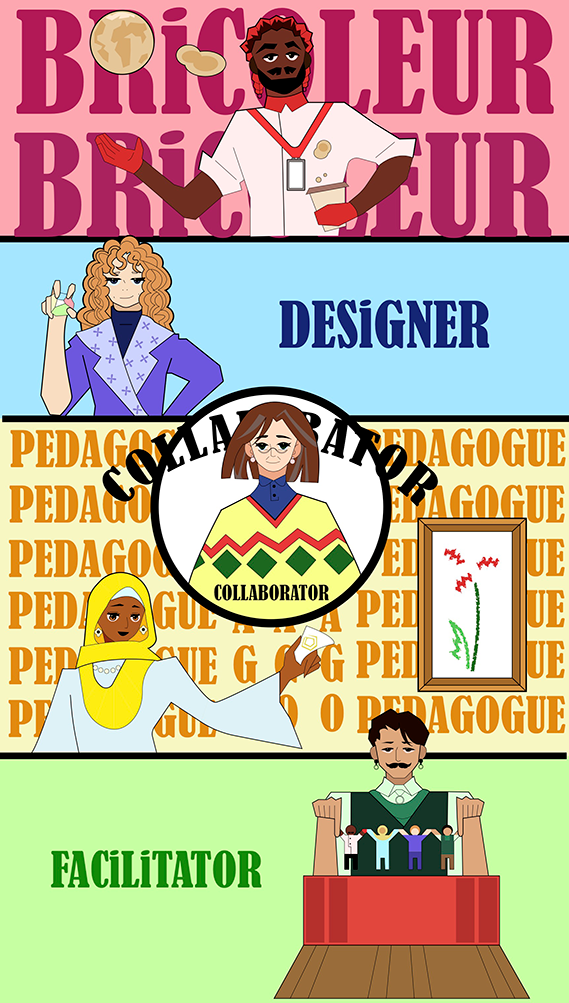
Profile of the trainer
Jari Karttunen, Jamk University of Applied Sciences
Seija Koskela, Jamk University of Applied Sciences
Illustration: Elsa Pyykkö, Pekka Halonen academy

Introduction
Modern learning theories as well as teaching or training practices emphasize the autonomy of the teacher. When they work with their students in their classrooms and all the doors shut, they have rather a great liberty to approach their learning contents in a way they prefer, naturally according to the learning goals set by authorities or the curriculum. This autonomy is very valuable and gives the teacher a lot of freedom to choose between different methods and approaches. Another question is if teachers are willing and able to use this autonomy or if they are prisoners of textbooks.
Erasmus+ project Move Your Mind is based on learner-centred ludo didactics. Ludo didactics means developing learning and learning behaviour with the principles of playfulness and utilizing the design processes and tools from game design. “Ludo didactics are the fusion of ‘thinking and acting like a game designer’ and ‘thinking and acting like a teacher/pedagogic expert”. In other words, ludo didactics is the shaping of pedagogical thinking and action by means of game elements and experiences. (Renger & Hoogendoorn 2019, 33.) Ludo didactics can be seen as supporting the autonomy and freedom of a teacher.
Trainer profiles
A few years back the Erasmus+ funded Move Beyond project (2019-2022) examined the profile of the trainer and developed a training frame work/guideline for trainers to educate, motivate and stimulate vulnerable youngsters through Art and Sport. Move Beyond project found out three different roles the trainer can take. Firstly, there is the role of a coach. It means that the trainer is there to help individuals to unlock their potential, to achieve their goals and to help them to learn from their experiences. Secondly, the trainer can take the role of a facilitator. Facilitator’s responsibility is to create an environment where everyone is encouraged to participate, share responsibility and build sustainable solutions. Thirdly, the trainer is an evaluator whose task is to discover training gaps and opportunities in order to improve training programs. To be able to meet all the requirements these different roles set to trainers, they need to have certain competences. In the Move Beyond project they selected “the seven competencies for a sparkling and effective trainer” by De Witte en de Zwarte Zwaan, a Dutch network of professional counsellors. (Move Beyond, Profile of the Trainer.)
However, in the current project Move Your Mind, we would like to go a bit deeper into the theoretical background of ludo didactics and clarify what kind of theoretical approaches describe or define the role of the teacher. The essential question here is if “a well-developed ludo didactical way of working puts the initiative completely in the students’ hands” (Renger & Hoogendoorn 2019, 29) what the teacher’s role is.
Current learning theories used by project organizations
The partner organizations use a variety of learning theories applied to the needs of their clients or trainees as well as to their specific area of education. The theories below were gathered as the project result of Move your mind. Learning theories were presented, discussed and shared between the partners with focus on their theoretical and methodical backgrounds. Below we describe the core ideas behind the most used and applied theories:
Constructivism is one of the most widely acknowledged theory behind learning, the developer behind this theory being Lev Vygotsky. Quite often we can add the prefix “socio” or “social” in front of the term. This is because, as far as we can see, learning never happens without some sort of communication or interaction with other people. In Dewey’s words (1938), learning is a social activity – it is something we do together, in interaction with each other, rather than an abstract concept. The primary responsibility of the teacher is to create a collaborative problem-solving environment where students become active participants in their own learning. From this perspective, a teacher acts as a facilitator of learning rather than an instructor. Students are encouraged to engage in dialogue both with the teacher and with each other.
One approach to learning which leans heavily on constructivism is experiential learning by Kolb. He developed the experiential learning cycle which is a four-step learning process that is applied multiple times in every interaction and experience: Experience – Reflect – Think – Act.
It’s thus a learning process primarily initiated by a concrete experience, which demands reflection, review and perspective-taking about the experience; then abstract thinking to reach conclusions and conceptualize the meaning of the experience; leading to a decision to act, engaging in active experimentation or trying out what you’ve learned. (Kolb 1984.) In other words, learning described here is also in a way learning by doing.
Authentic arts education is a pedagogical approach that criticizes the isolated and anachronistic nature of traditional arts education and its lack of connection to both contemporary, often interdisciplinary professional arts practice and to the needs of the student. Therefore, authentic arts education aims for meaningful connections between both the interests of the student, the professional world of the arts and contemporary societal issues. (Heijnen, Bremmer& Salonen, 2019.) Again, we come back to Dewey’s ideas: we learn by doing. To learn about art, students must do the work of artists – plan, develop ideas, and apply concepts to communicate personally meaningful ideas, as well as to develop artistic skills and their communication in the arts.
The theory of reasoned action was first proposed by psychologists Martin Fishbein and Icek Ajzen as an improvement of the information integration theory. It has been a leading theory in social psychology for the last few decades (Trafimow 2009). It aims to explain how people make decisions about their actions. According to it, an individual’s behaviour is influenced by their attitudes and subjective norms, which are based on their beliefs and perceptions of others. It assumes that individuals make decisions based on rational thinking and are aware of their attitudes and subjective norms. However, in reality, people may not be aware of their attitudes and subjective norms, and they may make decisions based on emotions or other factors. (Ajzen& Fishbein 1980.) It is not a learning theory and does not define the role of the teacher as such but it can be utilized when we try to understand the choices our students make.
When we compare the role of the teacher in these four different educational theories we can state that:
- In socio-constructivism, the role of the teacher is that of a facilitator and guide. The teacher creates a supportive and interactive learning environment where students actively engage with each other and the subject matter. The teacher encourages collaborative learning, group discussions, and problem-solving activities. They help students construct their own knowledge by providing scaffolding and asking probing questions. The teacher also respects and integrates diverse perspectives, fostering a sense of social interaction and shared understanding.
- In experiential learning, the teacher is a designer of meaningful experiences. The teacher’s role involves planning and organizing hands-on activities, experiments, and real-life situations that allow students to learn by doing. The teacher encourages active participation, reflection, and critical thinking. They guide students in making connections between their experiences and theoretical concepts. The teacher provides feedback and facilitates discussions to help students extract valuable insights from their experiences.
- In authentic arts education, the teacher serves as a mentor and curator of creative exploration. The teacher’s role is to inspire and nurture students’ artistic expression and creativity. They provide a balance between technical skills and individual artistic vision. The teacher encourages students to engage with the authentic artistic processes, explore various media, and develop a deeper understanding of cultural and historical contexts. Feedback and critique are essential components of the teacher’s role, helping students refine their artistic abilities and concepts.
- The theory of reasoned action focuses on behaviour and decision-making. In this context, the teacher’s role is to provide information and influence students’ attitudes, subjective norms, and perceived behavioural control. The teacher communicates relevant information, challenges existing beliefs, and encourages critical thinking about the factors that shape individual decisions. The teacher may also engage in discussions that explore societal norms, cultural influences, and personal values that affect behaviour. They play a key role in helping students understand the rationale behind their actions and guiding them toward informed choices.
In summary, while the specific roles of the teachers’ vary across these educational theories, a common thread is their function as facilitators, guides, and mentors who create engaging and meaningful learning experiences. Whether it’s fostering collaborative learning, designing experiential activities, nurturing artistic expression, or influencing decision-making, trainers play a vital role in shaping students’ understanding, skills, and perspectives within these educational frameworks.
When talking about ludo didactics there’s still one vital approach to the teacher’s role, namely that of utilizing the principles of game designing. In this sense a learning designer’s role is multifaceted and requires a combination of skills and competencies to create engaging and enjoyable gaming experiences. These competencies can vary depending on the specific type of games being designed (e.g., video games, board games, mobile games) and the complexity of the projects. Game designers need to generate innovative and unique ideas for game concepts, mechanics, characters, and worlds. Creativity is the foundation of designing captivating and memorable games. In Ludo didactics the cornerstone of the design is the student’s experience and the meaning they give to it (Renger & Hoogendoorn, 2019, 38).
The Ludo didactic training process and the teacher’s role in it
To find out how the ludo didactic training process was applied and adapted in the partner organizations we conducted a small-scale survey among the participants. Our aim was to gather information from participants about their attitudes, opinions, behaviors, and experiences regarding ludo didactics in their work. This information helped us to draw the profile of the ludo didactic teacher and the competences needed in applying ludo didactics in teaching and training.
The approach to gather information from the participants was conducted by using an open-ended questionnaire. An open-ended questionnaire allows the respondents to answer the question in their own words, without any pre-determined response options and thus it produces qualitative data to be analyzed and drawn conclusions of. (e.g. Young 2016.)
The partner organizations use both the terms “teacher” and “trainer” for professionals using and developing ludo didactics for and in their educational work. Sometimes these terms occur intertwined. We use “teacher” in this article to describe also trainers’ work and experiences of applying ludo didactics. However, in the quotes from the partners also “trainer” is used.
Ethical review and approval were conducted in accordance with European Union and local legislation and institutional and company requirements. Written informed consent to participate in this study was provided by the participants. Participation in the study was part of the Move Your Mind Erasmus+ project results.
The teacher in the ludo didactical designing proces
It is not always easy to adapt the teacher’s new role and start developing learning processes according to the ludo didactical principles. The different phases of the process can raise different kind of challenges. We asked our fellow participants to describe the challenges they met while designing the learning processes, what happened during the process, what promoted or prevented the design process and what kind of change or result was pursued.
The beginning of the design proces:
It may be difficult to start a collaborative design process if the backgrounds of the teachers are different, for example one of them has an academic teacher education and the other one has a more technical background. According to research the lack of a common language is the biggest obstacle in deep collaboration. Thus before starting the process it is good to clarify the terms and concepts used in the process. However, different backgrounds may also be an advantage:
“The differences were good. They learned from each other.” (partner 6)
A similarity in the background and experience of the teacher could be seen as a disadvantage:
“If the designers of the process have all got teacher’s education and deep understanding of pedagogy and they are experienced in designing learning processes according to the current learning theories used, it might be difficult to ´think outside the curriculum´” (partner 5).
A change that was aimed at?
Here are some answers from partner organizations about the change that was aimed at:
“We were aiming at a change in the students’ behaviour and motivation during their learning experience: learning should be fun, increase enthusiasm, self-confidence and independence as well as activity of the students, have the students to work without the teacher.” (Partner 5).
Partners’ student profiles vary a lot and one of the aims is to offer different kind of students, adult and young, “different kind of learning opportunities” (Partner 6).
“We used ludo didactics to support the self confidence of a learner and communication skills of the participants. This was implemented by creating ludo didactic actions and tools asking what’s your force or what can you do well as a learner.” (Partner 1)
“We expected change in the trainer’s thinking. A goal we pursued with the implementation of ludo didactics in our arts education workshops was to expand the toolbox of our trainers. One example is the focus on emotions or aesthetics: this is something that we naturally already built into our workshops, but which becomes more articulated by working with ludo didactics.” (Partner 4)
“It is important to keep in mind the playful learning and to change the mentality of the trainer”.
One aim was to arise change in learners during the process. This meant creating qualities that are extremely impressive to the learners.
“We wanted to create a wow-factor and fun for learning and curiosity. The goal was to change the way to design training activities. This meant to introduce more ludo didactics. Another aim was to introduce inspiration for the session with freelance trainers.“ (Partner 3)
What made the change possible or inhibited it?
“Designing the learning process according to the ludo didactical principles requires a lot of time, at least in the beginning of adopting it. A good preparation is essential. “ (Partner 5)
“The trainers’ enthusiasm is a prerequisite.” (Partner 3)
“The time required for the design process can even be discouraging for some.“ (Partner 3).
Also designing the training from the very start till the end has been one key component to succeeding and taking ludo didactics into practice by the teacher. This has given the teacher self confidence to lead and monitor the actions of the participants and guide their work and behavior.
“The self confidence of the trainer creates safety in the group.“ (partner 1).
“It is important that trainers are able to share experiences, expertise and ideas between professionals.” (Partner 7)
Sharing of thoughts and dialogue between the teachers even during the design process is vital. It is often described to help the process:
“It helps advance the design process when the trainer has extensive and in-depth knowledge of and experience with the prospective participants. That way, the various tools can be used in the most relevant way, and variations can be provided for various starting points and learning strategies of the participants. In this way, we can achieve our goals of providing each participant, departing from their individual starting points, with a rich learning experience.” (Partner 4)
“The idea was to make learning less “learning” and more attractive and fun. The time required for the process in order to rethink training with a ludo didactic approach can be discouraging too.” (Partner 3)
The enthusiasm of the teacher is seen as vital as well as the support and the encouragement of the superiors.
“A commitment to develop, test and use ludo didactics is connected to the enthusiasm of the teacher/ trainer but also to the operational possibilities within the organization given by our superiors. An enthusiastic director can enable a trainer to adapt to and create ludo didactic practices and applications in an organization.“ (Partner 2)
Required competences
When we think about designing traditional learning processes and the skills and knowledge requirements needed we acknowledge that the trainer needs to be professional in the content (or subject /field) and know the pedagogy, the current, student-centred, learning theories and their implementation in the learning process. Especially the latter brings along a rather massive list of skills to be fulfilled: you need to be able to design meaningful learning experiences, know your students and motivate them, evaluate and assess, provide appropriate feedback, collaborate with different stakeholders and so on depending in the environment and community you work in.
When thinking about ludo didactical design processes the teachers need to have skills that are usually combined to designing games.
“Key competences and skills a designer needs: open minded, don’t be afraid to fail, curiosity, perseverance, think out of the box, be able to create the right state of mind.” (Partner 3)
In the design process trainers need to shift their focus from the content to the aesthetics of the student’s experience (Renger & Hoogendoorn 2019, 81). Thus the trainers need the skill to think and design from back to front “Preja vu instead of déjà vu”, what kind of behaviour is expected to be seen (Renger & Hoogendoorn 2019, 82).
It is also often perceived that implementing ludo didactics requires more time in order to use the competences the trainer has and to take new skills in their competences.
“The belief in the role of the trainer is strong. The competences needed to develop an arts education workshop according to our methodology cover the competences needed to develop a ludo didactic activity. Training new trainers is certainly a challenge in this regard.” (partner 4)
Some of the partners stated that the role of the teacher was also giving a positive sign to students and give them preliminary information of a topic or theme to be discusses or studied later on.
“One important quality of the actions of the trainer is choosing the approach to learners and the mentality whilst using ludo didactics.” (Partner 2)
Finally, the deep understanding of the subject or subjects to be learned is important in order to use and commit to ludo didactics for better learning:
“A deep knowledge and understanding of the subject that needs to be learned, as well as in learning or didactics, are vital to a trainer using ludo didactics in their work.” (Partner 7)
It can also be seen that some difficulties may occur during induction as well as passing the knowledge and experience from one teacher to another:
“The organising part should provide a new trainer with detailed preparation material, counselling and perhaps one to one induction in order to take ludo didactics as their way of working and have the skills and competences as well as the self-knowledge to implement ludo didactics.“ (Partner 1)
Teachers profile
Our initial question was if “a well-developed ludo didactical way of working puts the initiative completely in the students’ hands” (Renger & Hoogendoorn 2019, 29) what the teacher’s role is. From the answers of our small-scale survey among project participants we can conclude that the teacher is the facilitator of the learning process – not in the front of the classroom but in the background. However, it does not mean that teachers are not needed – quite the opposite. In designing a ludo didactical learning process the teacher has several roles and responsibilities. And in accordance with these roles and bearing in mind all above said we can define the following roles for a ludo didactical teacher’s profile:
Role 1. Pedagogue
To be able to design a ludo didactical learning process the teacher needs to be familiar besides the principles of ludo didactics and its framework, also the core features of contemporary learning theories in their domain (whether it is e.g. school education, art education or museum pedagogy) as well as their implementation. To utilize ludo didactics as a framework can lead to the renewal and development of existing theories and methods to create aesthetic learning experiences for the students.
Role 2. Designer
The design process in ludo didactics resembles the design process in game design. The teacher needs first to define the learning goal, target group, the context and the learning experience. Then they need to prototype and test, and finally implement and evaluate.
The design process in ludo didactics is iterative. This means that the teacher can go back and forth between the steps, depending on the feedback and results they get. The design process is also collaborative – the teacher can work with other trainers, teachers, students, or experts to co-create and improve the design.
Role 3. Facilitator
A facilitator helps groups of people work together better, understand their common goals and plan how to achieve these goals.
A professional facilitator has good communication and group dynamics skills. They are able to able to create a positive, stimulating and safe environment for the participants, encourage participation and interaction, manage conflicts and disagreements, and deal with difficult or disruptive behaviors. In ludo didactical approach emotions are essential characteristics of the learning process thus it is extremely important that the facilitator recognizes them and is able anticipate them.
Role 4. Bricoleur
Bricoleur in education is a concept that challenges the dominant and conventional ways of thinking and doing in teaching, learning and designing learning processes. It is a concept that celebrates the diversity, creativity, and complexity of educational inquiry and practice. It is a concept that invites educators and learners to be curious, playful, and adventurous in their pursuit of knowledge and understanding. Bricoleur is inspired by the concept of bricolage developed by Lévi-Strauss.
A bricoleur uses a variety of methods and perspectives to explore and understand different phenomena. Examples of bricoleur could be a teacher who uses a mix of traditional and innovative strategies to engage students with diverse backgrounds, interests, and abilities in learning, or a student learner who uses various media, resources, and tools to explore a topic of interest and create a personal project or product. (See e.g. Rogers 2012, Freathy et al. 2017, Sharp 2019.)
Role 5. Collaborator
Although teachers and trainers have great autonomy in implementing their teaching or training they do not always work alone. Depending on the designing phase the teacher may need various other professionals to work with them. The role of a collaborator may be seen as work that builds cooperation between teachers and trainers as well as enhances curriculum development.
Conclusion
As far as we can see ludo didactics uses various learning theories, practices and approaches as well as theories of service design in the background or as a backbone of the method/approach/theory. What needs to be kept in mind is that as a ludo didactic designer the teacher is always designing learning behaviour hoping to create aesthetic learning experiences for the students to absorb the content, to experience it and to remember it through this experience (Renger & Hoogendoorn 2019, 49).
Learning (as well as teaching and training) can and should be fun and inspiring. It should be enjoyable in creating aesthetic learning experiences. If it means for the teacher to step aside then be it. A teacher who uses ludo didactical approach in their teaching has several roles which vary a lot according to the designing and training/teaching phases. As mentioned before it is important to give enough time to plan how to implement and use ludo didactics. Also one competence of the teacher is to diminish the role of the guidance of learning whilst the learners are gaming.
Every teacher or trainer has adopted their own theory-in-use which can differ from their espoused theory (Argyris & Schön 1974). Argyris and Schön (1974) suggest that people can improve their performance, i.e. teaching, by becoming more aware of their theories-in-use and aligning them with their espoused theories. This requires critical reflection, feedback, and dialogue to uncover and challenge the underlying assumptions and patterns of behaviour that shape their theories-in-use. These requirements apply when teachers are hoping to change their current learning process design and teaching methods and absorb the principles of ludo didactics both as their theory-in-use and espoused theory.
”The problem of the pupils is found in subject matter; the problem of teachers is what the minds of pupils are doing with the subject matter – The teacher has to be a student of the pupil’s mind.” (Nilssen & Solheim 2015)
Acknowledgements and funding
The study was conducted and supported by Erasmus+ project Move Your Mind funded by the Erasmus+ Call 2021 Cooperation partnerships in adult education (KA220-ADU) Grant (Project number: 2021-1-NL01-KA220-ADU-000030103).
Disclosure statement
Funded by the European Union. The views and opinions expressed are solely those of the authors and do not necessarily reflect those of the European Union or the European Education and Culture Executive Agency (EACEA). Neither the European Union nor the EACEA can be held responsible. The authors assert that there are no conflicts of interest to disclosure.
References
Ajzen, I., & Fishbein, M. 1980. Understanding attitudes and predicting social behavior. Englewood Cliffs, NJ: Prentice-Hall.
Argyris, C., & Schön, D. A. 1974. Theory in practice: Increasing professional effectiveness. New York: Jossey-Bass.
Dewey, J. 1938. Experience and education. New York, NY: Kappa Delta Pi.
Esf project Move Beyond 2019-2022, Profile of the Trainer https://drive.google.com/file/d/13OD8d6fyqgDhKd6WA89gGi3lohxc3vja/view
Freathy, R., Doney, J., Freathy,G., Walshe, K. & Teece, G. 2017. Pedagogical Bricoleurs and Bricolage Researchers: The case of Religious Education, British Journal of Educational Studies, 65:4, 425-443, DOI: 10.1080/00071005.2017.1343454
Heijnen, E., Bremmer, M. & Salonen, H. 2019. Interdisciplinary Arts Education from an Authentic Perspective https://journal.fi/rae/article/download/119025/70610/234979
Kolb, D. A. 1984. Experiential learning: Experience as the source of learning and development (Vol. 1). Englewood Cliffs, NJ: Prentice-Hall.
Nilssen, V. & Solheim, R. 2015. “I See What I See from the Theory I Have Read” Student Teachers Learning through Theory in Practice. Journal of Education for Teaching: International Research and Pedagogy, 41(4), 404–416.
Trafimow, D. 2009.The Theory of Reasoned Action. A Case Study of Falsification in Psychology. In Theory & Psychology vol. 19 (4): 501–518
Rogers, M. 2012. Contextualizing Theories and Practices of Bricolage Research. The Qualitative Report 2012 Volume 17, T&L Art. 7, 1-17 http://www.nova.edu/ssss/QR/QR17/rogers.pdf
Renger, W-J. & Hoogendoorn, E. 2019. Ludo Didactics. Designing for Didacticians. HKU Press.
Sharp, H. 2019. Bricolage research in history education as a scholarly mixed-methods design. History Education Research Journal, 16 (1): 50–62. https://doi.org/10.18546/HERJ.16.1.05
Young, T.J. 2016. Questionnaires and Surveys. In Zhu Hua, Ed. Research Methods in Intercultural Communication: A Practical Guide. Oxford: Wiley, pp.165-180. https://www.researchgate.net/publication/316228107_Questionnaires_and_Surveys#fullTextFileContent
Illustration: Elsa Pyykkö, Pekka Halonen academy